Introduction
Applying for a PhD is one of the most complex academic processes a student will ever navigate. Unlike undergraduate or taught postgraduate applications, PhD admissions combine academic judgement, research fit, funding constraints, and institutional risk assessment. As a result, success depends far more on preparation and structure than on raw intelligence.
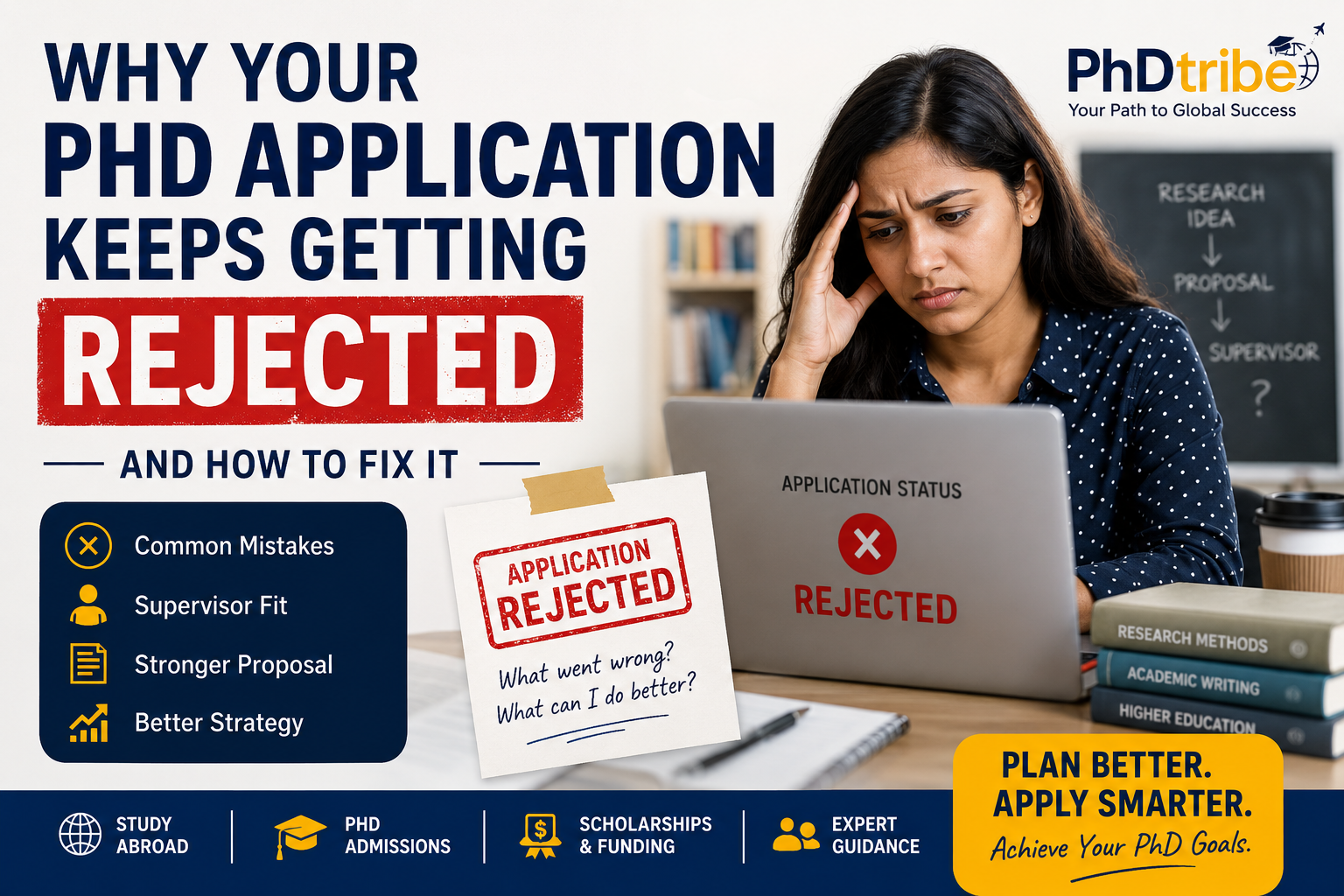
Many capable candidates are rejected not because they lack talent, but because they miss steps, misunderstand expectations, or prepare documents in the wrong order. A PhD application is judged holistically. Weakness in one area often undermines strength in another.
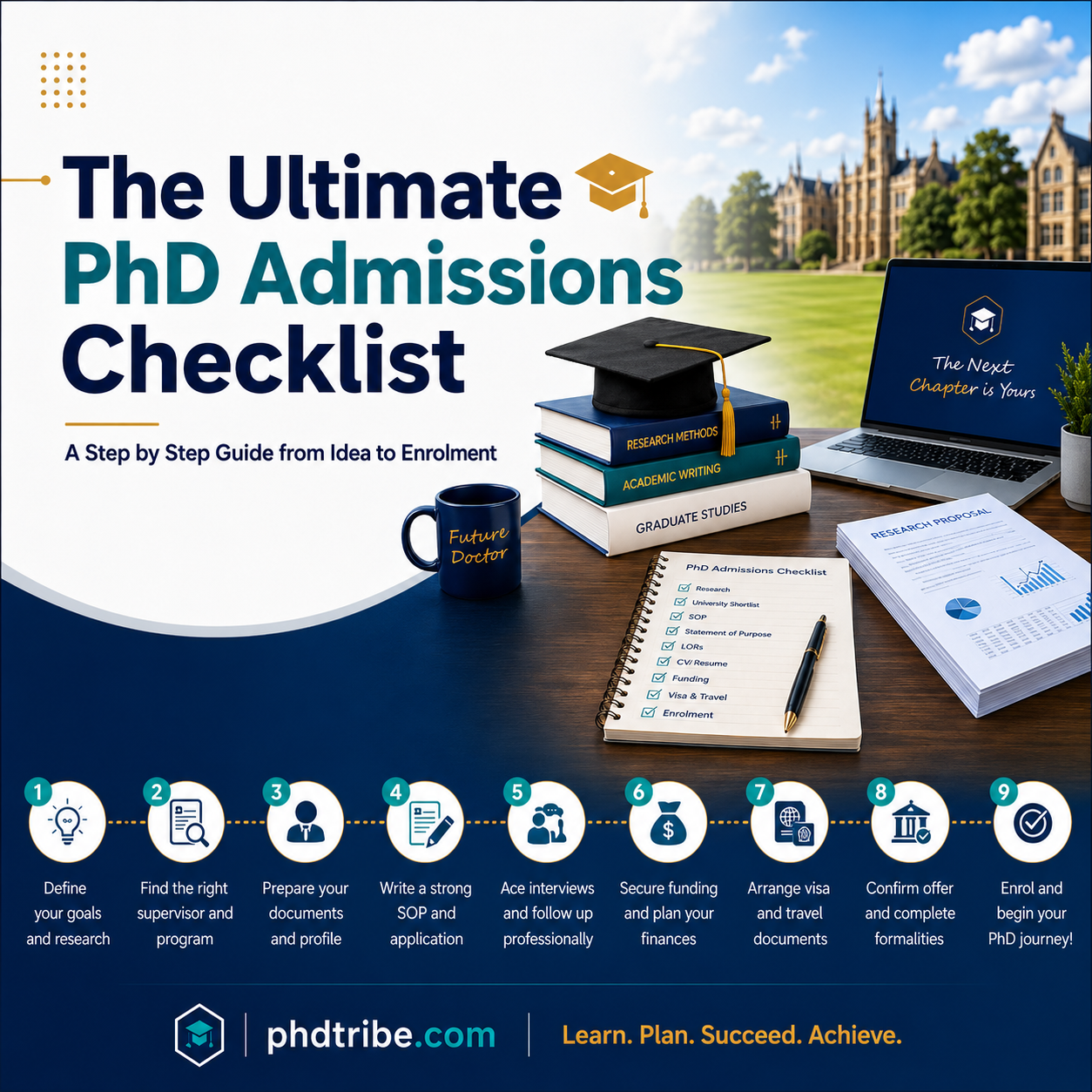
This article provides a comprehensive PhD admissions checklist, designed to help applicants move systematically from early preparation through to final enrolment. It reflects how admissions committees, supervisors, and graduate schools evaluate candidates across major international systems.
Phase 1: Pre‑Application Self‑Assessment
Before researching universities or contacting supervisors, the first step is inward.
Checklist 1: Confirming PhD readiness
Ask yourself honestly:
- Do I want to produce original research, not just complete coursework?
- Am I prepared for 3 to 6 years of sustained intellectual effort?
- Am I comfortable working independently with limited structure?
- Do I understand that a PhD is a training process, not a credential upgrade?
If the answer to these questions is unclear, it is better to pause than to apply prematurely. Admissions committees are highly skilled at detecting applicants who are uncertain or misaligned.
Checklist 2: Academic foundation review
Confirm that you meet the baseline academic expectations for PhD entry in your field:
- A strong undergraduate degree, usually upper second class or equivalent
- A Master’s degree for most countries, except the United States
- Evidence of research exposure, such as a thesis, dissertation, or publications
- Relevant methodological or technical skills, where applicable
Weak academic foundations typically result in rejection, regardless of motivation.
Phase 2: Defining Your Research Direction
A PhD application without a clear research direction is structurally weak.
Checklist 3: Research clarity
Before contacting any institution, you should be able to articulate:
- Your broad research area
- A narrowed topic or problem area
- Why this topic matters academically or socially
- Where your interests fit within existing scholarship
Your research interest does not need to be final, but it must be coherent and defensible.
Checklist 4: Feasibility reality check
Ask practical questions:
- Can this research be completed within a PhD timeframe?
- Are data, sources, or participants realistically accessible?
- Does this topic require funding beyond typical doctoral resources?
- Is specialised equipment or field access required?
Overambitious proposals undermine credibility.
Phase 3: Identifying and Evaluating Supervisors
At the PhD level, supervisor fit matters more than university ranking.
Checklist 5: Supervisor shortlisting
For each potential supervisor, verify:
- Active publications within the last five years
- Research alignment with your topic
- Prior experience supervising PhD students
- Institutional role stability
Avoid contacting academics solely based on title or prestige.
Checklist 6: Supervisor contact preparation
Before emailing a supervisor, prepare:
- A concise research summary
- A clear explanation of alignment
- A professional academic CV
- Awareness of their recent work
Generic or poorly targeted emails are rarely answered.
Phase 4: Understanding Country‑Specific Admission Systems
PhD admissions vary significantly by region.
Checklist 7: System awareness
Understand the structure of your target system:
- The UK and Europe often require a full research proposal at the application stage
- US programs emphasise statements of purpose and research interests
- Australia and New Zealand place strong emphasis on supervisor approval
- Some countries separate funding applications from admissions
Applying with the wrong expectations leads to avoidable rejection.
Phase 5: Preparing Core Application Documents
Each document contributes to the overall assessment.
Checklist 8: Research proposal
Your proposal should demonstrate:
- Clear research question or problem
- Awareness of key literature
- Appropriate methodology
- Feasible scope
- Expected contribution
The proposal tests your ability to think like a researcher.
Checklist 9: Statement of purpose or personal statement
This document should explain:
- Why this research area matters to you
- Why this department and supervisor are a good fit
- What you bring academically to the programme
- How the PhD fits into your long‑term goals
Avoid emotional narratives that lack academic grounding.
Checklist 10: Academic CV
A PhD CV should include:
- Education with research components highlighted
- Publications or working papers
- Research methods and skills
- Teaching or academic experience
- Conferences and presentations
Do not use job‑style resumes for academic admissions.
Checklist 11: Letters of recommendation
Strong referees are:
- Academics familiar with your research ability
- Supervisors of prior theses or dissertations
- Researchers who can comment on independence and critical thinking
Confirm early and provide referees with sufficient context.
Phase 6: English Language Requirements
English proficiency is often underestimated by PhD applicants.
Checklist 12: English test planning
Confirm:
- Accepted tests for your programme and department
- Minimum overall score and section requirements
- The test validity period is usually two years
- Whether waivers apply at the doctoral level
For PhD programmes, the Writing and Speaking sections carry disproportionate importance.
Checklist 13: PhD‑specific English expectations
For many PhD programmes:
- IELTS 7.0 to 7.5 is typical
- TOEFL iBT 95 to 105 is common
- Duolingo is often not accepted
- Higher scores may be required for teaching roles
Meeting the minimum does not guarantee competitiveness.
Phase 7: Funding Strategy
A PhD without funding is rarely sustainable.
Checklist 14: Funding awareness
Clarify:
- Whether the PhD position is funded or self‑funded
- If funding includes a stipend, tuition, and health cover
- Duration of guaranteed funding
- Conditions for renewal
Never assume all PhDs are funded.
Checklist 15: Scholarship alignment
When applying for funding:
- Note scholarship deadlines separately
- Check nationality or region restrictions
- Align research focus with funding priorities
- Prepare tailored statements
Funding decisions are often more competitive than admission itself.
Phase 8: Submitting Applications
Organisation becomes critical at this stage.
Checklist 16: Application logistics
Before submission, confirm:
- All documents uploaded correctly
- Referee submissions are complete
- Test scores sent officially
- Application fees paid or waived
- Deadlines accounted for time zones
Rushed submissions undermine strong applications.
Phase 9: Interviews and Selection Panels
Not all PhD programmes interview, but many do.
Checklist 17: Interview preparation
Prepare to discuss:
- Your research proposal in detail
- Methodological decisions
- Theoretical positioning
- Motivation for the programme
- Long‑term research goals
Admitting uncertainty thoughtfully is better than bluffing.
Phase 10: Offers, Conditions, and Decisions
Receiving an offer is not the final step.
Checklist 18: Offer evaluation
When reviewing offers, consider:
- Total funding package
- Supervisor availability and workload
- Department culture and completion rates
- Cost of living
- Visa support
The best academic brand is not always the best PhD experience.
Checklist 19: Conditional offers
If conditions apply:
- Confirm timelines for meeting conditions
- Clarify English or academic requirements
- Provide updates proactively
Delays can result in offer withdrawal.
Phase 11: Visa and Enrolment Preparation
Checklist 20: Visa readiness
Prepare:
- Offer letter and confirmation of study
- Financial evidence
- English test scores, if required
- Health insurance
- Academic transcripts
Visa refusals often stem from documentation inconsistencies.
Checklist 21: Pre‑departure planning
Before arrival:
- Secure accommodation
- Understand enrolment procedures
- Confirm orientation dates
- Arrange banking and insurance
- Prepare research start plans
Early organisation reduces first‑year stress.
Final Thoughts: What This Checklist Achieves
A PhD admissions process is not linear. Many steps overlap, loop back, or require revision. However, candidates who work systematically gain a decisive advantage.
This checklist does not guarantee admission. What it guarantees is that rejection, if it happens, will not be due to preventable mistakes.
Strong PhD applicants are not defined by brilliance alone, but by preparation, structure, and clarity of purpose.
If you are unsure, do not guess. Get informed guidance before you commit your time, money and hopes to a pathway that may not be right for you.