Introduction
Choosing where to study abroad can feel exciting at first.
You imagine the campus, the new country, the international experience, the degree, the career opportunities and the pride of saying, “I got in.”
Then reality begins to set in.
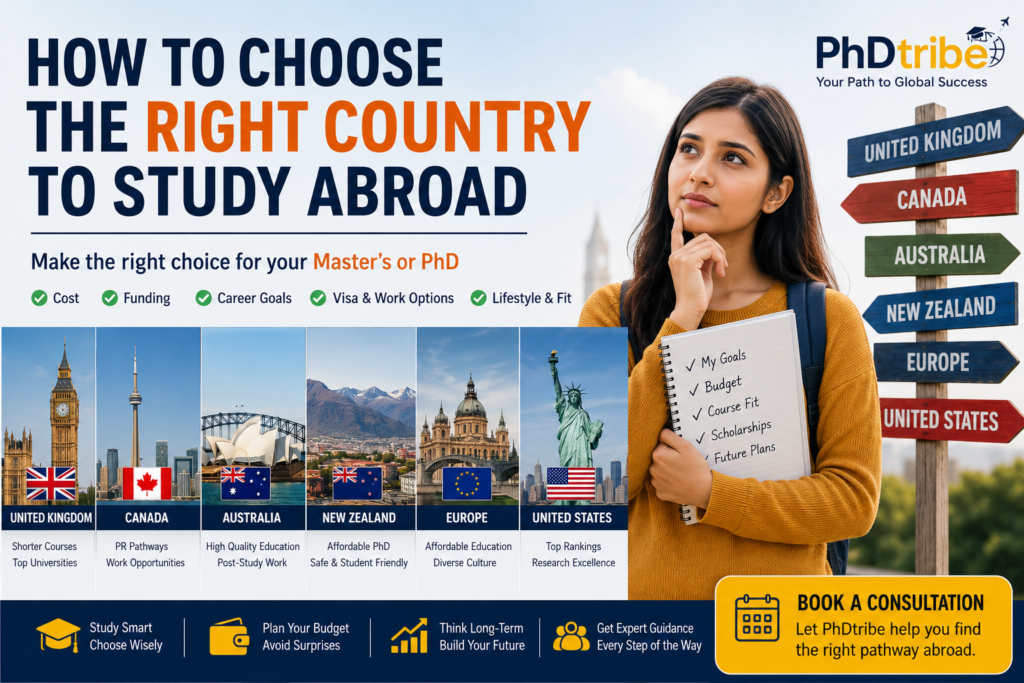
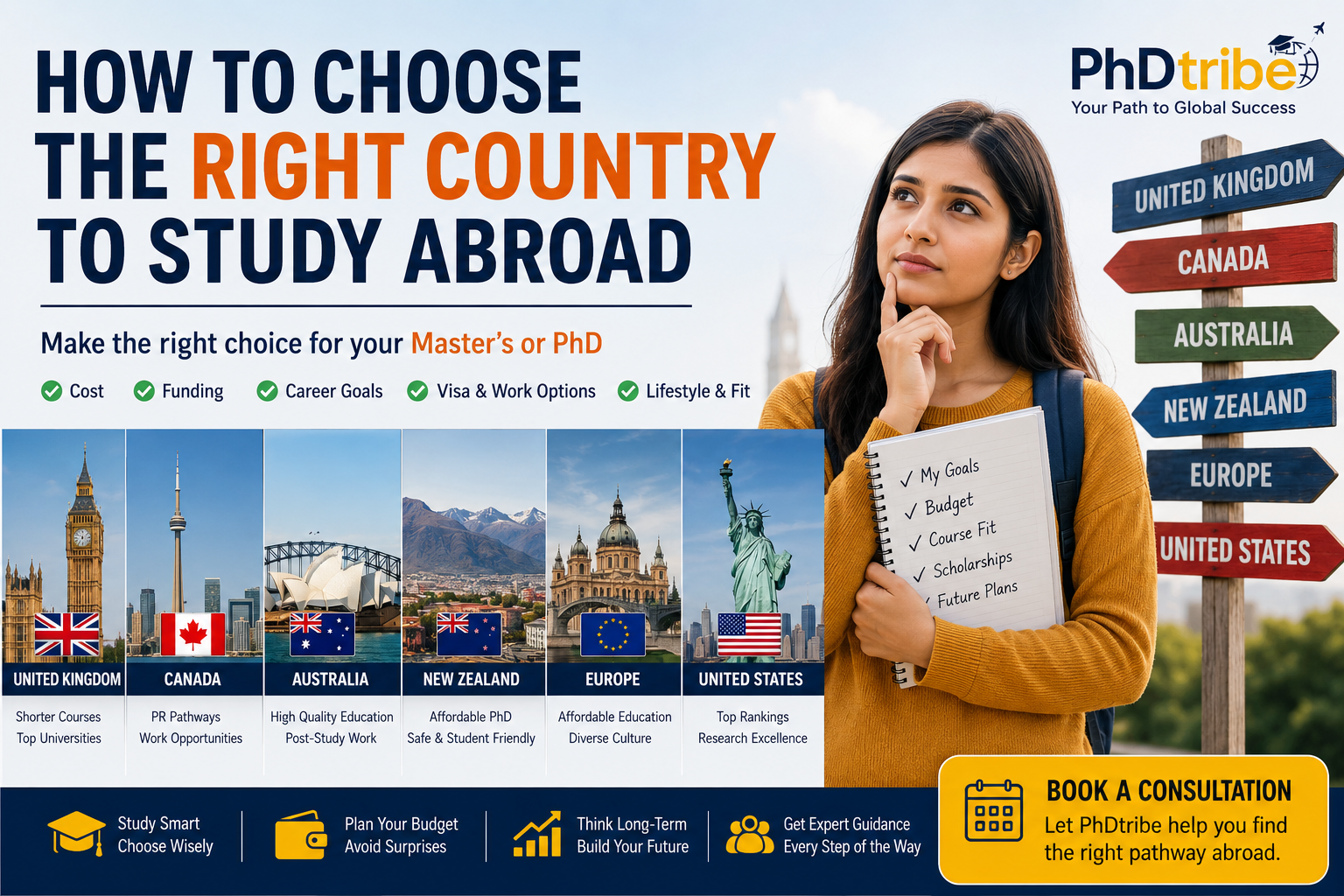
Should you choose the UK, Canada, Australia, New Zealand, Europe or the United States? Should you follow the country your friends are choosing? Should you choose the cheapest option? Should you focus on rankings? Should you go where there is a post-study work pathway? Should you apply where scholarships are available? Should you choose the country with the easiest admission process?
These are not small questions.
For many students, studying abroad is one of the biggest financial, academic and personal decisions they will ever make. The right country can open doors. The wrong country, or the wrong strategy, can lead to stress, debt, disappointment and missed opportunities.
At PhDtribe, the goal is to help students make education decisions that are informed, thoughtful and aligned with long-term goals. PhDtribe’s approach is independent, research-informed and future-oriented, encouraging students to think beyond admission and consider how education shapes long-term careers.
So, before you choose a country, pause and ask a better question:
- Which country best fits my academic goals, financial reality, career direction and long-term future?
Why Country Choice Matters More Than Many Students Realise
Many students begin their study abroad journey by asking, “Which country is best?”
But there is no single best country for everyone.
The better question is, “Which country is best for me?”
A country that is perfect for one student may not be suitable for another. A student applying for a taught master’s in business may need a different strategy from someone applying for a PhD in engineering, education, health sciences or social policy. A student with strong funding may have different options from someone who needs a scholarship. A student hoping to work internationally after graduation may need to think differently from someone planning to return home.
PhDtribe notes that students exploring undergraduate, master’s and doctoral study often face difficult decisions about universities, programmes, funding and long-term career opportunities. That is why clear, independent guidance matters.
Your country choice can affect:
- tuition fees
- living costs
- scholarship opportunities
- admission requirements
- programme structure
- research supervision
- visa rules
- post-study work options
- career opportunities
- family considerations
- settlement experience
- long-term return on investment
This is why choosing a country should not be based only on popularity, social media, rankings or hearsay.
-
Start With Your Goal, Not the Country
Many students start by saying, “I want to study in the UK,” or “I want to go to Canada,” or “I want to go to New Zealand because I heard it is good.”
That is understandable. Countries have reputations, and students are often influenced by family, friends, agents, alumni and online content.
However, the better starting point is your goal.
Ask yourself:
- What do I want this degree to help me achieve?
- Do I want academic progression?
- Do I want a career change?
- Do I want international work experience?
- Do I want a funded PhD?
- Do I want permanent migration possibilities?
- Do I want to build research expertise?
- Do I want a globally recognised qualification?
- Do I want industry exposure?
- Do I want a safer, quieter study environment?
- Do I want access to a specific academic field?
Once your goal is clearer, country comparison becomes easier.
For example, if your goal is a fully funded PhD, you may need to focus on countries with stronger doctoral funding structures in your field. If your goal is a one-year master’s degree, the UK may be attractive because many master’s programmes are shorter. If your goal is research supervision and a structured doctoral pathway, New Zealand may be worth exploring. If your goal is a paid doctoral researcher role, parts of Europe may offer suitable opportunities.
The point is simple: do not choose the country first and force your goals to fit later.
-
Compare Tuition Fees and Living Costs Honestly
Cost is one of the biggest factors in choosing where to study abroad.
Some students focus only on tuition fees and forget about living costs. Others look at the first-year cost but forget that exchange rates, rent, health insurance, transport, food and visa-related expenses can make the total cost much higher.
Before choosing a country, calculate the full cost of study.
Consider:
- tuition fees
- application fees
- visa fees
- health insurance
- accommodation
- transport
- food
- books and equipment
- flight costs
- emergency funds
- family or dependent costs
- currency exchange rates
- possible income from part-time work
A country with lower tuition may have high living costs. A country with higher tuition may offer stronger post-study opportunities. A scholarship may cover tuition but not living expenses. A master’s programme may be shorter but more intense and expensive upfront.
Do not rely on guesswork. Build a realistic budget before you apply.
-
Understand Scholarship and Funding Opportunities
If funding is important to you, your country choice should reflect that.
Scholarships are not distributed equally across countries, universities or fields of study. Some destinations have strong government scholarships. Some universities offer generous postgraduate funding. Some PhD opportunities are attached to supervisors, research grants or advertised projects. Some countries offer paid doctoral researcher positions, while others rely more heavily on competitive scholarships.
PhDtribe’s PhD Scholarships: The Complete Guide to Fully Funded Doctoral Study is a useful internal resource for understanding how doctoral funding works and why applicants should prepare early.
Before choosing a country, ask:
- Are international students eligible for scholarships?
- Are scholarships available in my field?
- Are they full or partial scholarships?
- Do they cover tuition only?
- Do they include living costs?
- Are there age, grade or nationality restrictions?
- When are the deadlines?
- Do I need admission first?
- Do I need supervisor support?
- Are PhD positions advertised separately?
Funding should not be an afterthought. For many students, it should shape the entire study abroad strategy.
-
Think About Programme Structure
Master’s and PhD programmes are not structured the same way everywhere.
In some countries, a master’s degree may be one year. In others, it may take two years. Some programmes are taught, some are research-based, and some combine coursework with a dissertation or thesis.
PhD structures also differ. Some countries expect applicants to develop a research proposal before applying. Others offer structured doctoral programmes with coursework. Some require supervisor contact before admission. Others allow applicants to apply centrally.
PhDtribe’s website explains that its advisory support helps students understand differences between global higher education systems, programme structures, admission expectations, timelines, scholarships and post-study pathways.
Before choosing a country, compare:
- degree duration
- coursework expectations
- research requirements
- thesis or dissertation structure
- supervisor involvement
- internship opportunities
- professional accreditation
- flexibility to change research direction
- assessment methods
- completion expectations
A country may be popular, but if the programme structure does not suit your learning style, academic background or career goal, it may not be the right choice.
-
For PhD Applicants, Supervisor Fit Is Critical
If you are applying for a PhD, do not choose a country without understanding how supervision works there.
In some doctoral systems, supervisor fit is central to admission. This is especially important in New Zealand, where applicants often need to identify suitable supervisors and demonstrate research alignment.
PhDtribe’s Choosing the Right PhD Supervisor in New Zealand is a useful guide for applicants who want to understand how supervisor fit can affect PhD admission.
PhDtribe explains that gaining admission into a PhD programme requires more than strong grades. Applicants must demonstrate research capability, develop a compelling proposal and secure alignment with potential supervisors.
Before choosing a country for PhD study, ask:
- Do I need to contact supervisors before applying?
- Are supervisors expected to support my application?
- Are advertised PhD projects available?
- Can I propose my own topic?
- How important is the research proposal?
- Does the country offer strong supervision in my field?
- Are supervisors accepting new students?
- Is funding linked to the supervisor or department?
A strong PhD application is not only about where you want to go. It is about where your research can be properly supported.
-
Check Career Outcomes, Not Just Admission Chances
Some students choose a country because admission seems easier. But admission is only the beginning.
You should also ask what happens after graduation.
Will the degree help you access the kind of career you want? Will employers recognise the qualification? Does the country offer work-integrated learning, internships, research networks or industry links? Is your field in demand? Will you be able to use the degree in your home country or internationally?
PhDtribe’s TribeCareers service focuses on helping students and graduates think beyond traditional routes and explore careers in industry, government, consulting, entrepreneurship and other knowledge-intensive roles.
Before choosing a country, consider:
- graduate employability
- post-study work options
- industry connections
- professional registration requirements
- employer recognition
- research networks
- internship or placement opportunities
- career services
- alumni outcomes
- transferability of the qualification
A degree is not just a certificate. It is part of your career story.
-
Consider Visa and Post-Study Work Pathways Carefully
Visa and post-study work rules can strongly affect the value of your study abroad decision.
However, these rules can change. What was true last year may not be true today. This is why students should always check official government websites or work with qualified immigration professionals where formal advice is needed.
PhDtribe provides general guidance about study pathways but does not offer formal immigration advice. Its website notes that immigration partners can assist where needed.
Before choosing a country, ask:
- Can I work while studying?
- How many hours can I work?
- Can my spouse or dependents join me?
- Is there a post-study work visa?
- How long is the post-study work period?
- Does the degree level affect eligibility?
- Are there occupation lists or skills requirements?
- Is there a pathway to longer-term work or residence?
- Will my field support future employment?
Do not choose a country based only on someone else’s migration story. Policies change, and individual circumstances matter.
-
Think About Your Personal Well-being
Students often overlook well-being when choosing a country.
They compare tuition, rankings and visas, but forget to ask: Can I live well there?
Studying abroad can be rewarding, but it can also be emotionally demanding. You may face loneliness, financial stress, culture shock, academic pressure, racism, homesickness or uncertainty about the future.
Your well-being matters because it affects your academic success.
Before choosing a country, think about:
- climate
- safety
- cost of living
- community support
- cultural familiarity
- religious or spiritual community
- healthcare access
- mental health support
- accommodation options
- transport
- distance from family
- family friendliness
PhDtribe’s approach includes care, wellbeing, transparency and long-term sustainability, recognising that success in education is academic, professional and personal.
A country may look perfect on paper, but if the environment does not support your well-being, your study experience may become difficult.
-
Do Not Choose Based Only on Where Your Friends Are Going
It is natural to be influenced by friends and family.
If people around you are going to Canada, you may feel Canada is the best option. If everyone is talking about the UK, you may feel left behind if you choose elsewhere. If a friend had a good experience in Australia, you may assume Australia will be right for you, too.
But your background, finances, field, goals and profile are different.
Your study abroad decision should be personal.
Friends can share useful experiences, but they should not make the decision for you. Their pathway may not match your needs.
-
Avoid the “Any Country Is Fine” Mindset
Some students say, “I just want to leave. Any country is fine.”
This is understandable, especially when people feel stuck, frustrated or eager for a new opportunity. But this mindset can lead to poor decisions.
Not every admission offer is a good offer.
Not every course is worth the cost.
Not every country fits your long-term plan.
Not every university has the right support.
Not every pathway leads to the outcome you want.
Before accepting any offer, ask:
- Why this country?
- Why this university?
- Why this programme?
- Why now?
- What will this cost me?
- What are the realistic outcomes?
- What happens after graduation?
If you cannot answer these questions clearly, pause before committing.
-
Create a Country Comparison Table
A practical way to choose the right country is to compare your options side by side.
You can create a simple table with these categories:
- country
- preferred universities
- programme options
- tuition fees
- estimated living costs
- scholarships
- visa rules
- post-study work options
- career prospects
- family considerations
- application deadline
- strengths
- risks
- overall fit
This helps you move from emotion to evidence.
For example, one country may have attractive post-study work opportunities but high tuition. Another may offer affordable PhD study, but fewer funding options in your field. Another may have excellent supervisors but limited scholarship opportunities.
Seeing everything in one place helps you choose strategically.
-
When Should You Start Planning?
Start earlier than you think.
We recommend preparing ideally 8 to 12 months before your intended start date because early preparation improves application quality and scholarship opportunities.
If you are applying for highly competitive scholarships or PhD funding, you may need even more time.
Early planning gives you time to:
- compare countries properly
- research universities
- understand funding options
- prepare documents
- contact supervisors
- request references
- sit English language tests if needed
- meet deadlines
- avoid rushed decisions
Rushed applications are often weaker applications.
How PhDtribe Can Help You Choose the Right Country
Choosing the right country for your master’s or PhD abroad is not just about finding a university. It is about building a pathway that makes sense academically, financially, professionally and personally.
PhDtribe supports students exploring undergraduate, master’s and PhD programmes through TribeAdmissions. This includes choosing the right country, university and programme selection, identifying potential supervisors, application preparation, scholarship and funding opportunities, and understanding visa and study pathways.
PhDtribe can help you:
- compare study destinations
- understand country-specific admission systems
- identify suitable universities and programmes
- explore scholarship and funding options
- understand PhD supervision expectations
- prepare stronger applications
- think through long-term career outcomes
- avoid costly mistakes before applying
You can start with these useful internal resources:
Summary
Choosing the right country to study abroad is not about following the crowd.
It is about understanding your goals, your budget, your academic profile, your career plans and your personal circumstances.
The best country for you is not always the most popular one. It is the country where your education, funding, wellbeing and long-term future can align.
Before you apply, ask yourself:
- What do I want this degree to help me achieve?
- Can I afford the real cost?
- Are scholarships available?
- Does the programme fit my goals?
- Are there realistic career opportunities?
- Do I understand the visa and post-study work rules?
- Will I be supported academically and personally?
- Does this country make sense for my future?
If you are unsure, do not guess. Get informed guidance before you commit your time, money and hopes to a pathway that may not be right for you.